



Why Smart Teams Still Misunderstand Each Other
A project is running late. The manager asks everyone to speak up immediately if the deadline is at risk. One employee raises the issue right there in the meeting. Another checks with colleagues and follows up later that afternoon. A third waits to bring it up privately. The manager needs the same piece of information from all three, but the conditions that help each person share it may look very different.
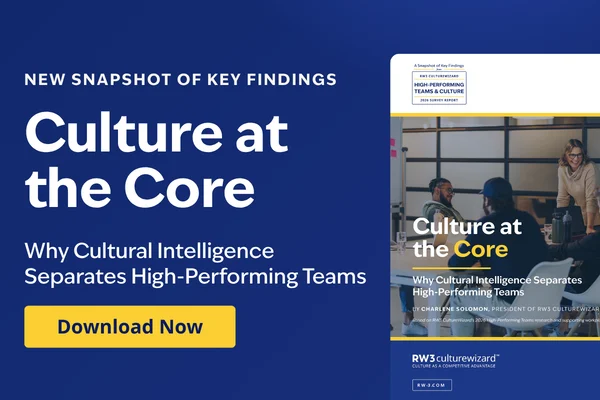
This is exactly the kind of situation cultural intelligence training can help teams learn. RW3 CultureWizard's fourth Snapshot reports that 65.9% of respondents rated communication-style differences at least moderately challenging on global teams, while 62.7% said the same about cultural differences in decision making.
Training works best when it starts with challenges the team is actually facing: the decisions they're making, the meetings they're running, the deadlines they're managing, and the feedback conversations they're navigating.
A scenario like the late project above is a useful place to begin. Participants can walk through it together and consider what each person might be assuming about hierarchy, consultation, directness, and timing. Once those assumptions are visible, the team can decide together which expectations they want to make explicit in their own work going forward.
Here's what that can look like in practice. A team discusses how members can raise concerns about a deadline in ways that fit their working relationships and comfort with speaking openly. They might contribute during a meeting, share written input beforehand, or speak privately with the project owner or an appropriate team leader.
The team also clarifies who has decision-making authority, who should be consulted, and how the outcome will be communicated. These agreements create several ways to contribute while making responsibilities clear.
Managers can also pause to consider what may be shaping a behavior before drawing conclusions. Silence in a meeting may mean someone is thinking through their response, showing respect for seniority, preferring to discuss concerns privately, or feeling uncertain about whether disagreement is welcome.
Taking more time to reach a decision may reflect the need to consult colleagues, build agreement, or seek approval. Asking respectfully about these expectations helps managers understand the situation and agree on an approach that supports the team's work.
These are possibilities to explore with curiosity, and they should never become labels for individuals or nationalities.
RW3's 2026 study found that 90.6% of respondents on high-performing teams agreed cultural awareness improves team effectiveness, compared with 59.2% on other teams. Respondents with comprehensive training were also more likely to describe their teams as high-performing than those with no formal training (96.2% versus 62.4%). These findings show a meaningful association, though they don't establish that training alone created high performance.
What training can do is give teams a starting point, and the real progress comes from continuing that practice in everyday work. One of the simplest ways to do that is to bring the team back to its agreements after a difficult interaction.
What did each person expect going in? Where did those expectations diverge? What will the team make clearer next time?
The more often a team practices this kind of reflection, the more cultural intelligence becomes a shared way of working, especially when pressure is high and the stakes are real.
Sources:
RW3 CultureWizard. 2026. High-Performing Teams Don't Just Happen. Study overview. RW3 CultureWizard, Snapshot 04 Culture at the Core.
Schlaegel, Richter, and Taras. 2021. Cultural intelligence meta-analysis.