



Critical Feedback Without Damaging the Team: Why high-performing teams need balance and psychological well-being
The head of product development knows the market. The engineers know the technology. The regional managers know the customers. Expertise isn't the problem. The problem is that each of them reads the meeting differently. A nod means agreement to one person and polite acknowledgment to another. One expects pushback out loud; another expects to be asked. So the meeting ends with some convinced a decision was made and others assuming it's still open, while the person with the concern that could change everything is still waiting for an invitation to speak.
What this team is missing is a shared understanding of how decisions get made, how disagreement is supposed to surface, and what participation actually looks like. When those expectations stay unspoken, teams end up revisiting decisions that everyone thought were settled, missing information that was right there in the room, and losing time they can't afford to lose.
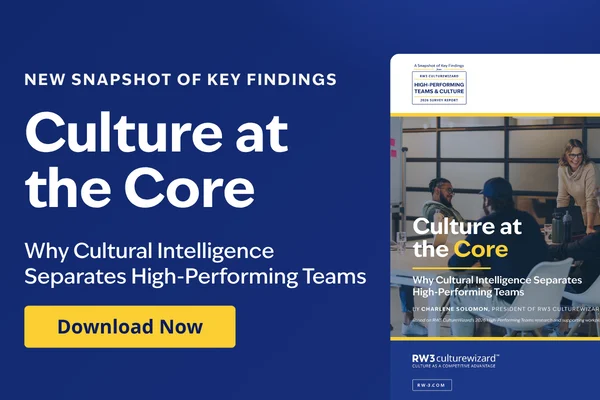
RW3 CultureWizard's new Snapshot, Culture at the Core: Why Cultural Intelligence Separates High-Performing Teams, draws on our 2026 study of 1,179 global professionals. Among respondents on high-performing teams, 92.1% said people feel comfortable sharing ideas and perspectives, compared with just 54.6% on other teams.
Trust followed the same pattern: 92.7% versus 54.1% said their team culture actively encourages it.
Culture shapes all of this. It influences who speaks first, whether people feel comfortable challenging a leader in a group setting, and what counts as agreement. A direct response in a meeting and a quiet follow-up afterward may both reflect a commitment to the work. But if a manager reads one as engagement and the other as hesitation, the team loses access to information it needs.
Cultural intelligence gives leaders a way to examine these differences without making assumptions about the people involved. Consider a manager whose project has fallen behind schedule. The first instinct is often to push harder for updates, but the delay frequently traces back to the same gaps described above: a decision some people never realized was final, a risk no one felt invited to raise, or work that stalled while two groups waited on each other.
A manager with cultural intelligence treats the delay as a signal to find out what isn't being said. Inviting written input before the next meeting gives people who prefer to think before they speak a way to flag the issues slowing things down. Explicitly welcoming respectful pushback during the conversation makes it easier for someone to say the timeline is unrealistic or the plan has a flaw. Checking in privately afterward with team members who tend to raise concerns outside the group brings in information that would otherwise surface too late. And closing the meeting by naming the decision, the owner, and the deadline out loud prevents the rework that comes from people leaving with different understandings of what was agreed. Each step goes after a reason the project slipped, so the team can get back on track instead of losing more time.
These practices matter most under pressure, which is exactly when people tend to fall back on their most familiar ways of communicating and deciding. In our survey, 65.9% of respondents rated communication-style differences at least moderately challenging, and 62.7% said the same about cultural differences in how decisions get made.
A good starting point is agreeing on a handful of questions as a team: Who has the final call? Who needs to be consulted before that call gets made? How should someone raise a concern if they disagree? What gets documented after the meeting, and by whom? Those agreements will need to evolve as the people and the work change.
High-performing teams can thrive with people who operate differently. It just takes a shared understanding of those differences and a commitment to putting everyone's expertise to use.
Sources:
RW3 CultureWizard. 2026. High-Performing Teams Don't Just Happen. Study overview.
RW3 CultureWizard. 2026. Culture at the Core: Why Cultural Intelligence Separates High-Performing Teams.