





What Cultural Intelligence Means in the Age of Artificial Intelligence
Imagine stepping through a looking glass, expecting to see a familiar reflection, but finding an entirely different landscape instead. This is precisely what happens when organizations try to export a localized Diversity & Inclusion (D&I) playbook to a global workforce without adapting it.
To build a genuinely connected team, we must look through the looking glass and deeply examine how cultural differences impact inclusion. What spells "belonging" in San Francisco might spell "discomfort" in Tokyo or Mumbai.
The One-Size-Fits-None Trap
Many organizations fall into the trap of assuming that inclusion is a universal language. It isn’t. When designing a global inclusion strategy, headquarters often lean heavily on corporate norms rooted in a single cultural perspective.
For instance, encouraging employees to "speak up, disrupt, and challenge authority" feels empowering in highly individualistic cultures. However, in collectivistic or hierarchical cultures, forcing this approach can feel disrespectful or psychologically unsafe.
To move past this, organizations must pivot toward authentic multicultural inclusion practices. This means recognizing that inclusion requires active translation:
- Communication Styles: Moving from a standard of aggressive "airtime" in meetings to structured turn-taking that respects indirect communicators.
- Feedback Loops: Adjusting performance reviews to account for cultures where direct public praise—or blunt criticism—is discouraged.
- Recognition: Celebrating achievements in ways that honor the collective team rather than just the individual, where culturally appropriate.
Building a Framework That Flexes
Instead of a rigid checklist, multinational companies need a dynamic global inclusion framework. At RW3 CultureWizard, we ground this framework in our proprietary 8 Dimensions of Culture model. Think of it as a house: the foundation and pillars are your core corporate values (like innovation, respect, and psychological safety), but the interior design is left entirely to local teams.
The Global-Local Balance
A robust framework doesn't force conformity; it builds a bridge between corporate intent and local reality. It allows a regional office to say, "We share the company goal of inclusive collaboration, and here is how that uniquely manifests in our cultural context."
Up-Skilling for the Global Stage
Navigating these cultural matrices isn't just a matter of good intentions—it’s a learned business skill. If your leaders are managing cross-border teams with a single-culture mindset, gaps will inevitably form.
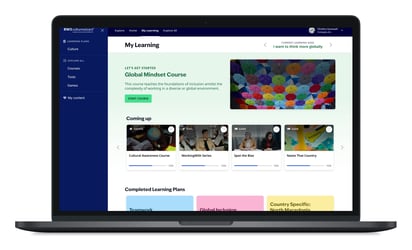
To bridge this divide, RW3 CultureWizard offers a comprehensive Global Inclusion Course as part of our expansive digital learning library. Learners can even use our Global Inclusion Calculator to build a personalized Inclusion Profile and identify unique areas for growth.
For teams that thrive on social learning and real-time collaboration, we also offer CultureWizard LIVE—our premium Instructor-Led Training (ILT) experience led by certified intercultural facilitators. Whether you choose the self-guided digital path or our customized ILT workshops, your teams will learn how to:
- Decode cross-cultural communication nuances.
- Adapt inclusion initiatives to local social and cultural realities.
- Foster genuine psychological safety across hybrid, multinational teams.
The View from the Other Side
Rethinking inclusion isn’t about changing what your organization stands for; it’s about expanding how you listen. By stepping through the looking glass, we stop expecting the global workforce to reflect our specific view, and finally start appreciating the full, brilliant mosaic.
Ready to equip your team with the skills to work effectively across differences? Visit www.rw-3.com to explore our digital courses, ILT workshops, and intercultural assessments.

.png?width=500&height=500&name=Blog%20Image_Global%20Leadership%20Dont%20Always%20Translate%20Regionally%20(1).png)